
Why AI-Generated Tests Still Need Human Judgment
AI-generated tests expand coverage, but human judgment is essential for validating risk, business context, and meaningful quality signals.
AI Can Accelerate Test Design—But It Does Not Understand Your Product

Language models can transform a plain-English requirement into a useful starting point for test automation. Given a statement such as, “A new user should sign up, verify email, and reach the dashboard,” an AI system can suggest happy-path steps, validation checks, data variations, and likely edge cases. This reduces the time required to move from product intent to executable coverage, especially for teams without large QA organizations. Tools such as BugPilot AI can also run generated scenarios across browsers, devices, and environments, then return screenshots, recordings, logs, and traces when something fails.
The important limitation is that generation is not the same as understanding. A language model may interpret “verified email” as a successful API response while missing the requirement that the link expire after ten minutes. It may assume a standard password policy, overlook regional compliance rules, or create assertions that confirm appearance rather than behavior. AI testing is therefore most valuable as a force multiplier for test strategy, not as an autonomous authority on quality. Human reviewers still need to clarify intent, identify critical workflows, and decide which outcomes truly matter to customers and the business.
Where False Confidence and Brittle Assumptions Appear
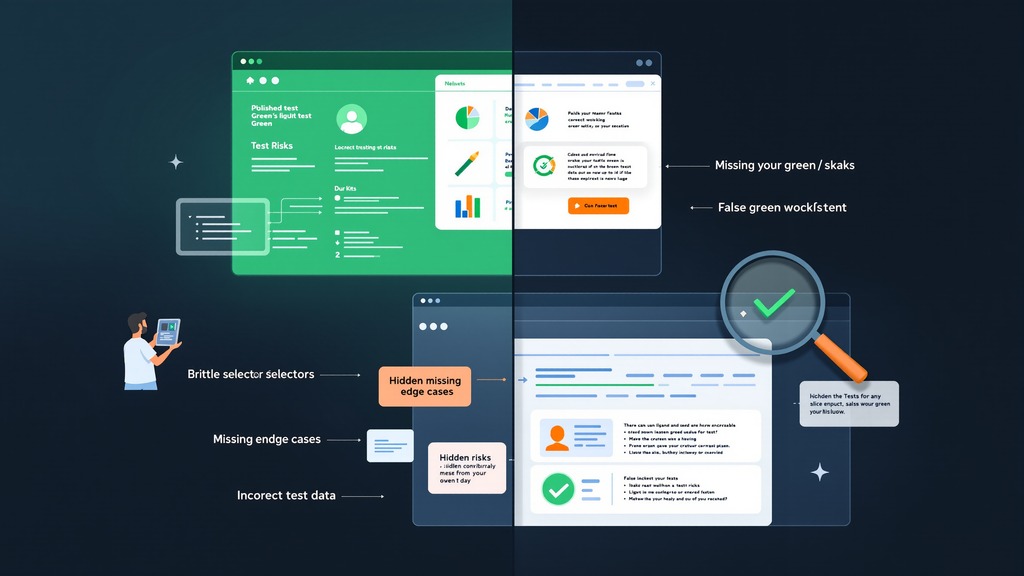
The greatest risk in AI-assisted testing is not an obvious failure; it is a convincing test that passes while checking the wrong thing. Generated tests can inherit ambiguous requirements, use unrealistic data, or assert implementation details that change during routine development. A test might verify that a button exists without confirming that the correct account is created, or confirm a dashboard loads without checking whether its data belongs to the signed-in user. Passing results can create false confidence when the assertions are shallow or incomplete.
Brittleness is another concern. A language model may choose selectors tied to visual labels, generate timing assumptions, or reproduce a single narrow user path. Small UI changes, asynchronous services, localization, third-party outages, or permission differences can then produce noisy failures—or cause important scenarios to remain untested. Effective quality assurance requires reviewers to examine generated steps, assertions, test data, and cleanup behavior. They should ask: What risk does this test cover? What would a real user experience? Which failure would be unacceptable? Evidence-rich reporting from systems such as BugPilot AI helps diagnosis, but it does not replace that critical evaluation.
A Practical Human-in-the-Loop Review Model

A reliable approach is to give every AI-generated test a structured review before it becomes release-critical coverage. First, product and domain experts confirm the intent: users, permissions, business rules, compliance needs, and failure consequences. Next, QA engineers review the scenario design, adding boundary conditions, negative paths, accessibility checks, and environment-specific risks. Developers then validate that the assertions observe meaningful behavior rather than fragile implementation details. This shared review turns a generated draft into a deliberate test strategy.
Teams can make the process repeatable with risk tiers. Low-risk checks may be approved quickly, while payment, authentication, privacy, and data-loss scenarios require explicit human sign-off and periodic review. Track the source requirement, expected outcome, test owner, evidence, and last validation date. When a test fails, inspect its recording, console logs, traces, and reproduction steps before changing the test or the product. AI testing works best when it expands exploration and speeds execution while humans retain accountability for quality decisions. The goal is not to remove judgment, but to apply it where it has the greatest impact.